
Job Sharing for Employees: How it Works
Welcome to the world of job sharing that is collaboration, flexibility, and balance. Imagine a scenario where two individuals team up to conquer a role, tag-teaming responsibilities while creating a harmonious work-life symphony. Join us on a journey through the dynamic landscape of job sharing, where professionals find equilibrium and employers retain their brightest stars.
Benefits of Job Sharing
Two talented professionals, each working part of the week, weaving their skills together seamlessly to complete a full-time role. It’s a game of hours and expertise, where the workload is divided in a way that suits both and maintains the company’s momentum. While one might work 20 hours, the other gracefully takes on 15, or perhaps the split is different – the arrangement is as unique as a fingerprint. Job sharing isn’t just about sharing tasks; it’s about sharing success.
Life’s juggling act can leave anyone feeling like a plate-spinner at times. Job sharing has emerged as a lifeline for those seeking balance. Professionals yearning for more family time or personal pursuits can now join forces with a like-minded partner. This shared responsibility not only keeps the job wheels turning but also offers a chance to recharge and rejuvenate.
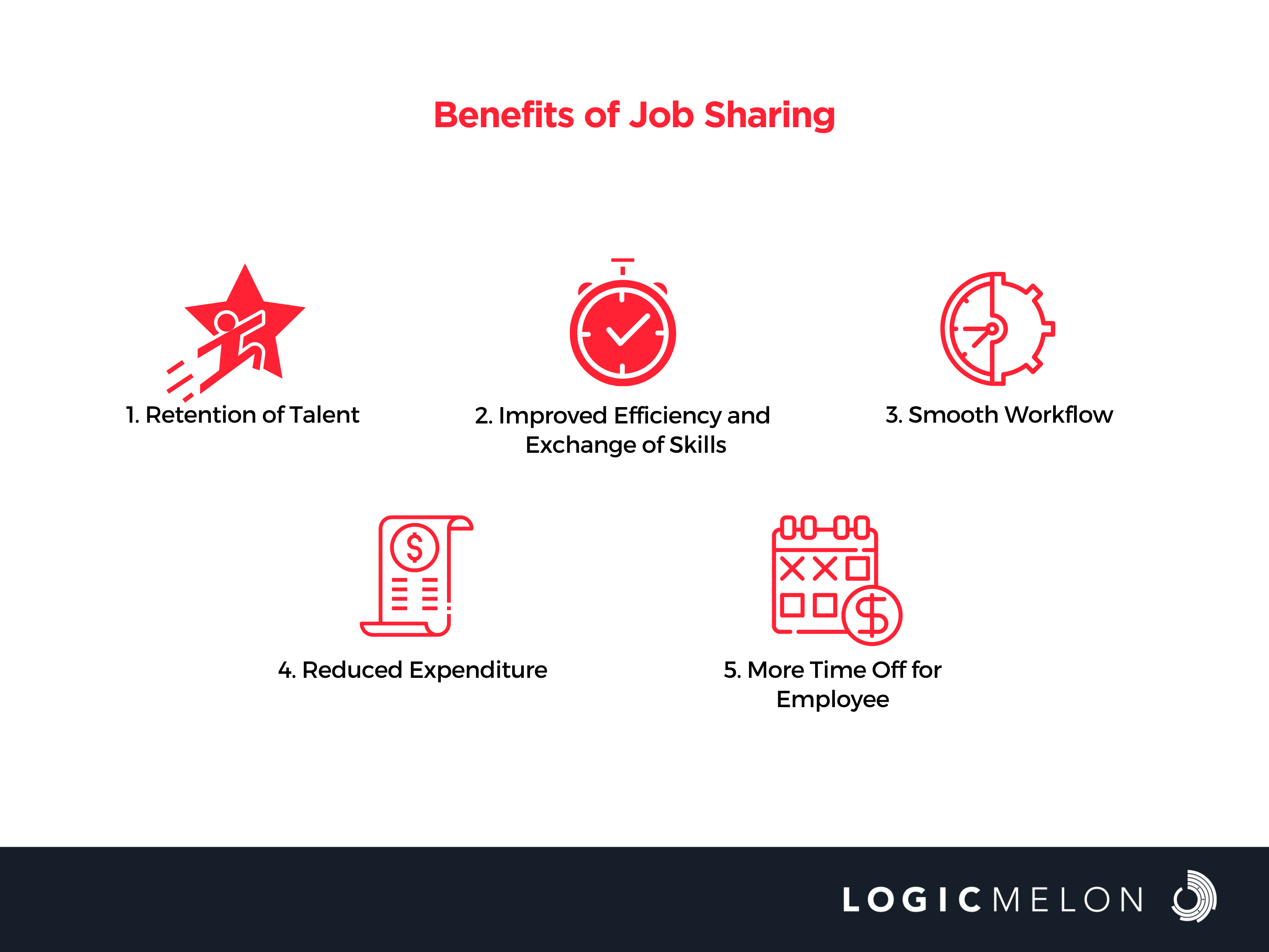
1. Retention of Talent
Imagine a workplace tango where two skilled workers glide through challenges hand in hand. Job sharing retains valuable expertise even during uncertain times, like the recent pandemic upheaval. With both employees well-versed in the role, they become a dynamic duo, facing any hurdles with panache.
2. Improved Efficiency and Exchange of Skills
Think of job sharing as a dynamic stage to showcase skills. As partners switch seamlessly, the stage lights up with efficiency. Each partner brings their A-game, complementing strengths and offsetting weaknesses. The result? A harmonious performance that’s greater than the sum of its parts.
3. Smooth Workflow
The show must go on, even when one partner takes a brief bow. In the world of job sharing, the rhythm stays steady. If one partner jets off for a vacation or a well-deserved break, the other slips effortlessly into the spotlight, ensuring the performance continues without a hitch.
4. Reduced Expenditure
For organisations facing cost constraints, job sharing is a smart choreography. Instead of laying off a talented performer, employers can craft a new routine – one that retains valuable talent while easing payroll pressure.
5. More Time Off for Employee
Imagine having more hours to twirl with hobbies, family, or even another part-time gig. With job sharing, one partner can take a bow while the other takes centre stage. It’s a rhythm that ensures a well-rounded performance, on and off the stage.
Limitations of Job Sharing
1. Workplace Problems
On the job-sharing, partners must master the art of coordination. Effective communication is the secret sauce here – partners must ensure they’re stepping in rhythm, sharing updates, and collaborating seamlessly.
2. Supervision Challenges
Monitoring productivity and managing the administrative shuffle of leaves and tasks requires finesse. But the result? A work that keeps the show running smoothly.
3. Compatibility Issues
In this tango, compatibility is key. Partners must blend seamlessly, sharing responsibilities and benefits. It’s a duet that demands trust, compromise, and mutual understanding.
4. Responsibility
Balancing the workload between partners requires a choreographer’s precision. Task division must be clear, with each partner taking their cues and executing their part flawlessly.
How it Works
The key to a successful job-sharing partnership lies in the magic of compatibility. Choose a partner with whom you can communicate effortlessly, share both agreements and disagreements, and work together in harmony.
Poor communication is affecting trust for 45% of workers. Clear communication is the spotlight that keeps the workplace illuminated. Partners must stay in sync, ensuring that the rhythm of work flows seamlessly between them.
Frequently Asked Questions
1. What is job sharing?
Job sharing involves two employees collaborating to perform a single role. They work part-time, alternating days, or as per a schedule that suits both their needs and the organisation’s objectives.
2. How is compensation determined in job sharing?
Compensation is usually based on the hours worked. Each employee receives a portion of their salary proportionate to the agreed-upon workload.
3. How do job-sharing employees coordinate tasks?
Effective coordination relies on regular communication and shared tools like calendars and digital platforms. Meetings and updates ensure a smooth transition of responsibilities.
Closing Thoughts
In the world of job sharing, professionals become work partners, weaving their skills and aspirations into a harmonious routine. It’s a choreography that empowers individuals to find work-life balance, stay engaged, and avoid burnout. During a challenging economic time, recruiters can avoid laying off employees and implement a job-sharing plan. This approach helps retain talented employees for the organisation. By retaining talent, employers can avoid the cost of hiring and training new workers.
LogicMelon
Award-winning recruitment software that will find, attract, hire and analyse the way you want to work. At LogicMelon, we have experienced software recruitment marketing specialists to help you build effective recruitment solutions supported by the best customer service you’ll find anywhere!
Email: sales@logicmelon.com or call LogicMelon (UK) +44 (0) 203 553 3667 (USA) +1 860 269 3089

Do’s and Don’ts for Hiring a Boomerang Employee
In the recruitment process, you must use every method that brings you promising talents and contributes to your organisation’s growth. In that regard, a boomerang employee returning to your organisation after some time is someone you cannot overlook.

Hybrid Work Model: Definition and Advantages
After the sudden hit of the global pandemic, organisations have started to adopt the remote work model as the norm. But still, some organisations can never completely switch to remote working. These organisations use a hybrid work model that helps them get the best of both working remotely and working from the office.

5 Employer Branding Strategies Using Social Media
Any candidate who wants to join your company’s recruitment process will do extensive research even before completing the job application. This is where employer branding strategies are needed to make your company look good.